
What Do We Risk by Coming Closer? Emilia González Salgado’s December ‘25 Exhibition
Before I saw anything clearly that night, I heard music, voices overlapping and moving through the space. As I entered the gallery space, I noticed others engaging with each other, lingering, smiling and laughing softly, hesitating, and finally inhaling. The physical environment was all too familiar, a gallery space, yet here, at the Lines of Flights exhibition presented by CASA, something was being asked of me—the viewer.
In this exhibition, What do we risk by coming closer?, artist Emilia González Salgado’s work was not exhibited safely behind barriers, but required proximity and gesture to be “viewed.” As the entry wall-text described:
“González Salgado assembles a series of pieces that turn proximity into method. Built through the slow labor of making, they transform this gallery space into a field where small negotiations between body and object begin to take shape.”
Through sculpture, installation, textile, scent, and gesture, González Salgado created a realm where memory existed tangibly and locally. Through her works, memory—whether personal or shared—became spacial, physical, and relational.
This feeling was uncanny in a formal gallery space. Art institutions alike have trained us to stay behind the line—not to cross, not to touch, be wary of any alarm, cruel in its potential embarrassment. We learn these rules early: true observation requires respect, and that respect is communicated through distance. But here, the opposite was true. But what would happen if I came closer? Was there an idea of too close? Was there a right or wrong way to “view” González Salgado’s works? And more importantly, what was being asked of me?
As I made my way through the exhibition, my body began to move in circles. Back and forth, around again, rereading texts and revisiting scents. The central work that beckoned viewers into interaction was Palma que Camina (The Walking Palm). Tall, expansive, and quietly insistent, the sculpture extended outward into individual porcelain flowers, each holding its own associated scent. The work did not reveal itself at a glance, but its meaning unfolded only through intentional physical approach.
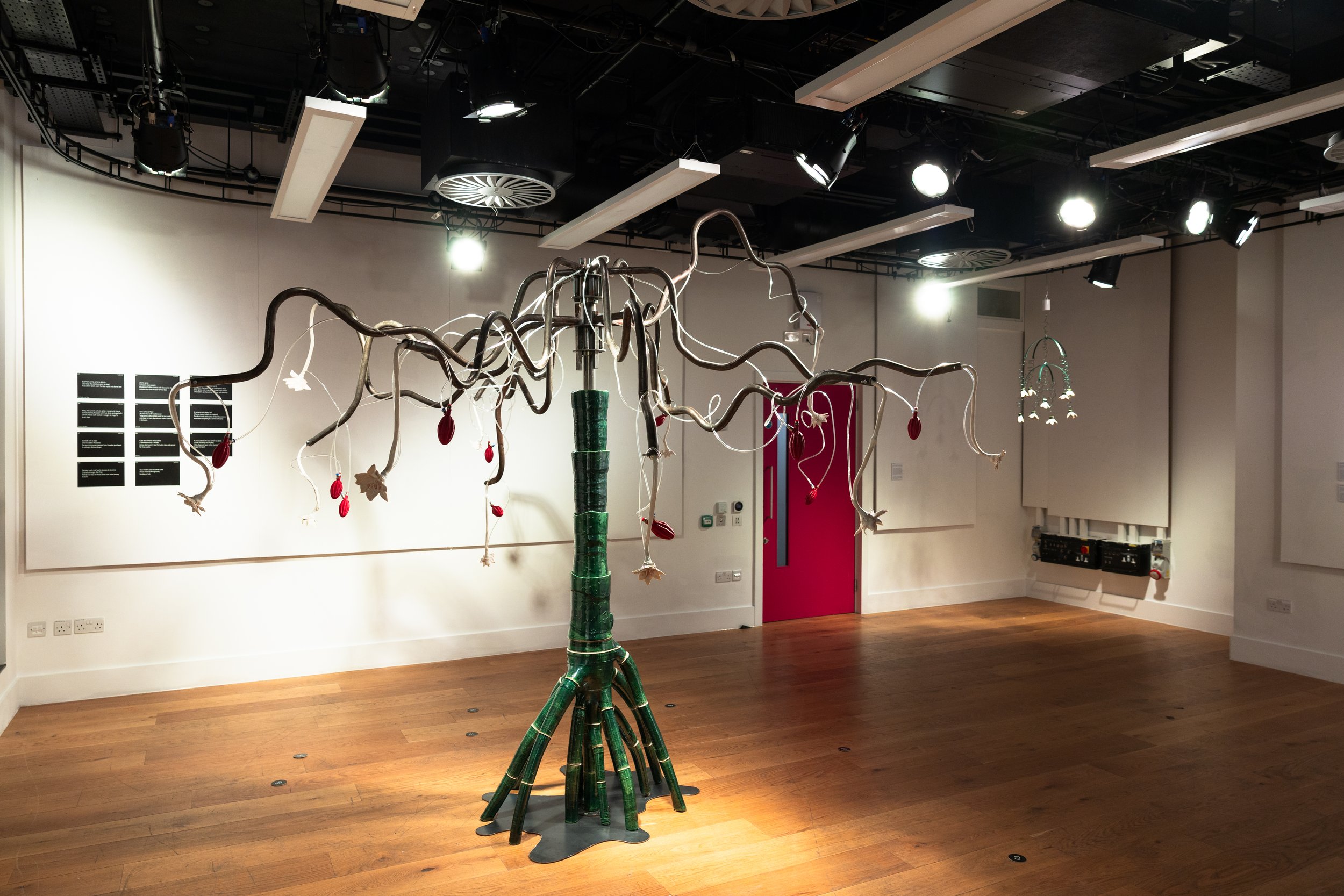
Palma que Camina, clay, steel, porcelain, rubber, vapour-distilled essences, 2024
Viewers were asked to lean in, stretch their arms, and gently squeeze the pumps connected to the flowers, releasing vapour-distilled scents that González Salgado gathered over the course of a year in London. These scents were subtle and intimate, never overwhelming. The interaction required care, an attentiveness similar to listening closely when someone shares a personal memory. It made me wonder what we are actually risking by coming closer. Is proximity itself the risk, or is it the unlearning of behaviours shaped by institutions that separate art from bodies through barriers and rules?
Is there also a risk in becoming visible as a viewer, in being seen engaging, hesitating, reaching?
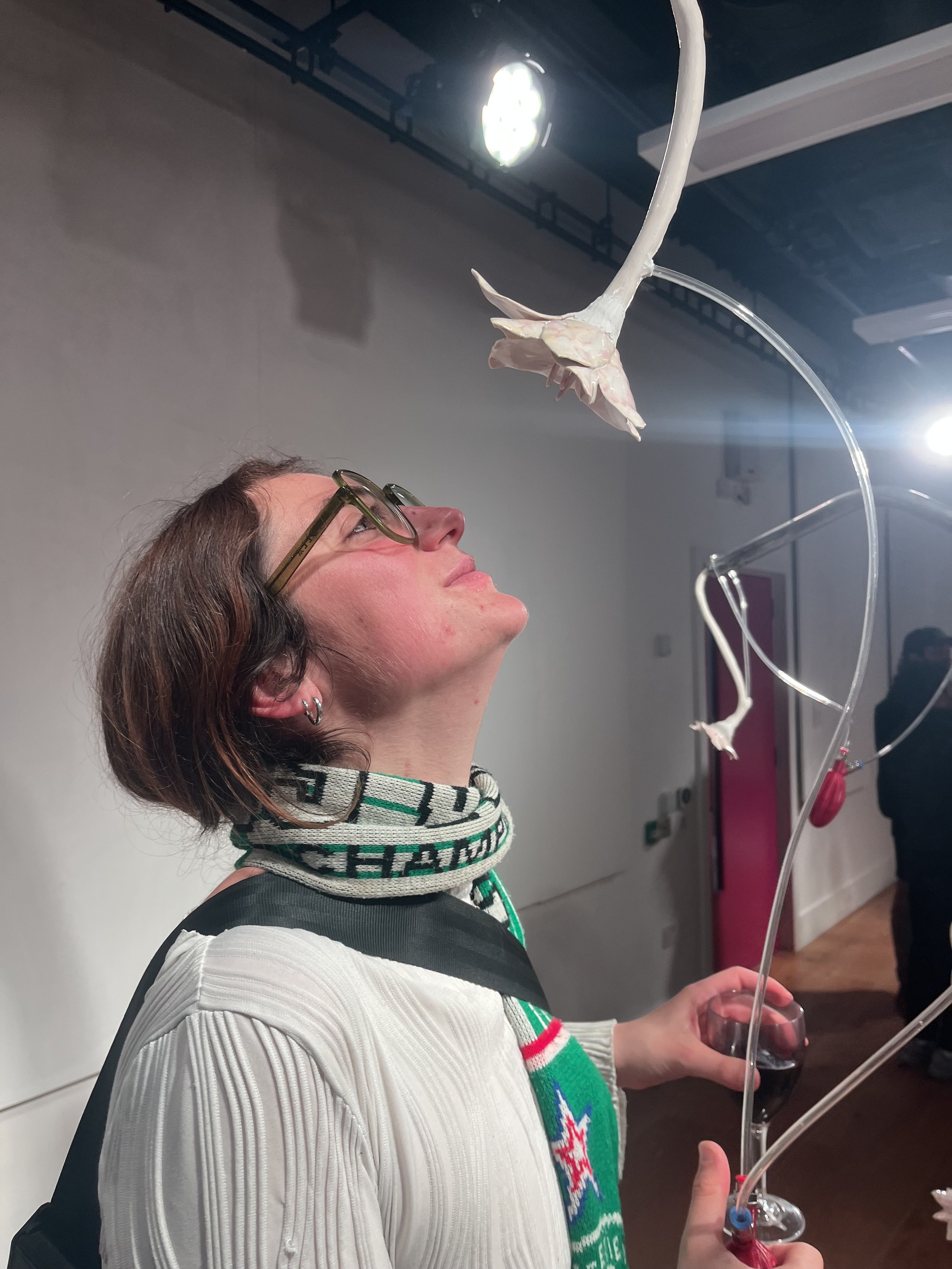
Molly participating in Palma que Camina at the exhibition opening.
Watching others interact with the work, I saw hesitation give way to curiosity. People glanced around before touching, then softened. The work required effort, a reaching, a pressing, a closeness, and in return it offered memory, not as image, but as sensation.
The palm takes its name from Socratea exorrhiza, a tree known for its slow movement in search of light. Shifting centimetres at a time, it becomes a quiet metaphor for adaptation and survival. This sense of slow negotiation between body, environment, and time runs throughout the exhibition.
This attention to proximity reappears in Suelo de Páramo (Ground Study No. 9), part of an ongoing body of work that evokes the Ecuadorian highland ground through textile and scent. Digitally knitted in merino wool, mercerised cotton, and elastic, the piece is based on studies of ten by ten centimetre sections of páramo terrain. These fragments are abstracted into colour and texture before being reconstructed into larger compositions. A vapour-distilled scent of Antisana ground lingers close to the surface, subtle and almost evasive.
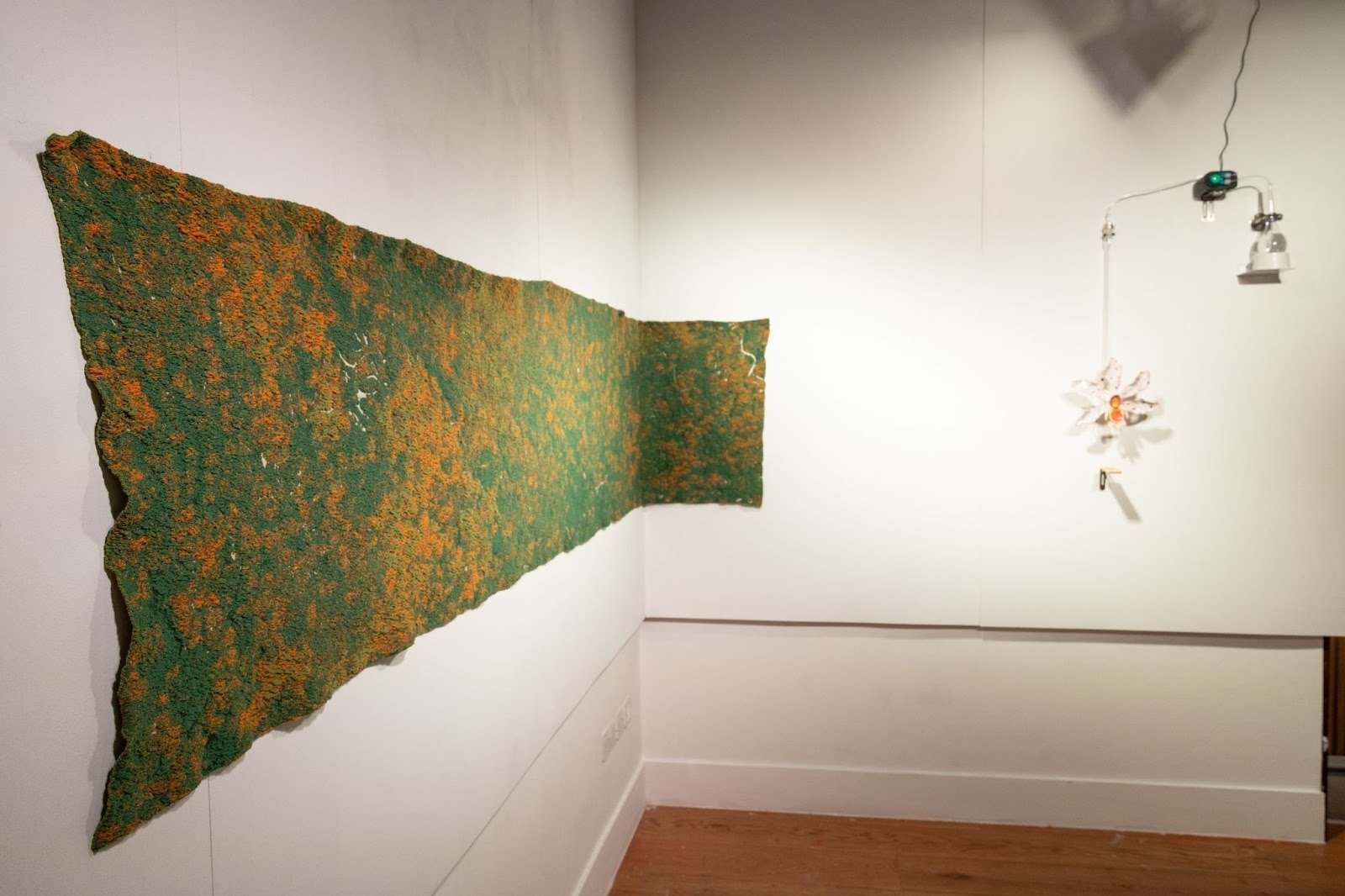
Suelo de Páramo (Ground Study No.9), merino wool, mercerised cotton, elastic, vapour-distilled scent from Antisana ground, on-going
Looking closely at the surface of the textile becomes a way of examining how distance shapes our sense of place, what settles on the surface and what remains suspended in memory. Here, land is not mapped from above, but encountered through fibre, smell, and scale. The work resists the extractive logic of cartography that flattens territory into legible outlines. Instead, it proposes a haptic mapping that honours fragmentation, touch, and intimacy.
Textile practices have long carried cultural memory, particularly within Indigenous and diasporic contexts, where weaving becomes a method of preservation, storytelling, and resistance. In Suelo de Páramo, the ground itself is translated into cloth, inviting the viewer to encounter landscape as something lived rather than possessed. For those living in diaspora, this gesture resonates deeply. Memory does not remain intact— it frays, stretches, and recomposes itself across geographies. Folklore, land, and ancestral knowledge persist not as fixed origins, but as surfaces we return to repeatedly.
This sense of holding contradiction brought me back to Silvia Rivera Cusicanqui’s analysis of ch’ixi, an Aymara concept describing a state of juxtaposition without dissolution, a state of coexistence without resolution. Not hybridity or fusion, but tension held honestly. Grey, uneven, and contradictory. This feels especially relevant when thinking about diasporic life in the UK, where memories are shaped away from the landscapes that once sustained them. Where do these memories live when geography changes? How do we maintain spiritual and embodied relationships with nature when that relationship is mediated by distance?
When I spoke with curator Gabriela Román González, she emphasised the importance of oral histories within folklore. Stories survive not through fixation, but through movement, repetition, and transformation. González Salgado’s works function in a similar way. They do not stabilise meaning, they activate it. They depend on bodies to complete them. Smell becomes an alternative form of knowledge, one that bypasses language and moves directly through memory. Perhaps the risk at play is not proximity, but vulnerability. The risk of becoming visible. Of being seen leaning in, touching, smelling, remembering. Of allowing art to implicate us rather than protect us through distance.
In a cultural moment where institutions increasingly reinforce separation through barriers, surveillance, and controlled access, What do we risk by coming closer? offers another proposition.
Memory needs bodies. Knowledge can be sensory. Closeness is not a transgression, but an act of care.
Living in a metropolis like London, a landscape often disconnected from visible ecologies, it can be easy to forget our relationship to the natural world and our role within it. González Salgado’s works invite interaction in ways that mirror how we might approach trees, flowers, or soil. Carefully. Tentatively. Responsibly. In doing so, the exhibition makes space to consider not only memory and diaspora, but also our relationship to land, damage, and responsibility, even as the root causes of environmental devastation remain bound to systems of capital.
In her book, Staying with the Trouble, Donna Haraway writes about resisting the urge to resolve discomfort too quickly in our current environmental state, and to work towards a livable future by staying present. González Salgado’s work does exactly this. It does not offer closure. It invites us to linger, to sit with uncertainty, and to accept that memory, like scent, is unstable. It fades, returns, and changes depending on who encounters it.
Without human interaction, these works would remain suspended. Through touch, breath, and attention, they are remembered into being. Perhaps the quiet risk we are being invited to take is learning to hold more than one truth at once. To accept contradiction without needing resolution. To come closer, not to claim understanding, but to remain present.
And maybe that is where remembrance begins. When we come closer, we risk never finding a singular answer.
What Do We Risk by Coming Closer? has now concluded at CASA, Brixton House, but it remains part of CASA’s year-long Lines of Flight programme. As part of this series, I conducted an in-depth interview with artist Emilia González Salgado and curator Gabriela Román González, focusing on the exhibition and the collaborative relationship between artist and curator, particularly how proximity, care, and shared authorship shaped both the work and its presentation. The full conversation can be read via Not The Owners as part of the ongoing Lines of Flight series.
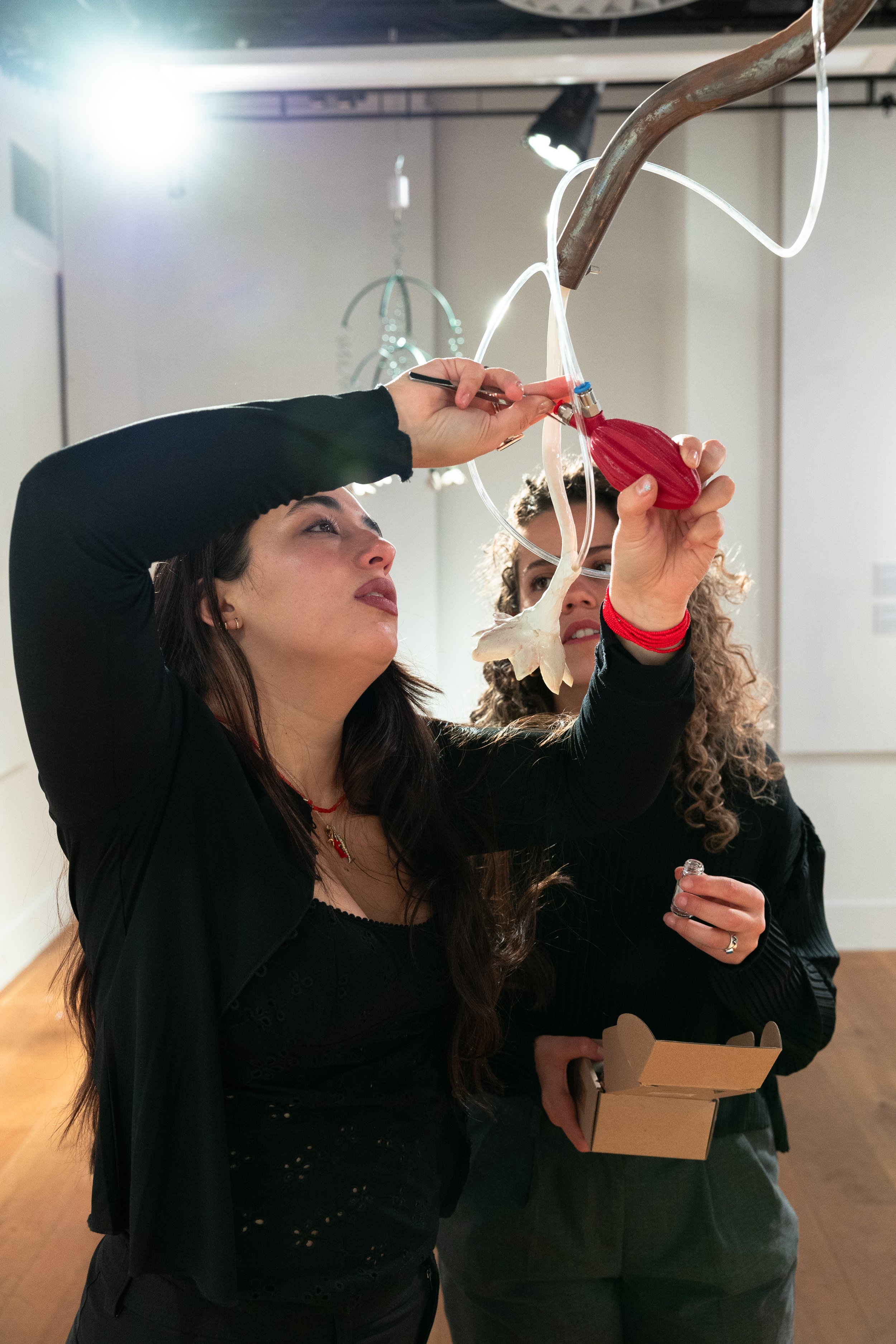
Artist Emilia González Salgado (left) and curator Gabriela Román González (right) installing Palma que Camina.
Curated by Gabriela Román González
Presented by CASA Festival, Not The OWners and Brixton House as Part of Lines of Flight
Photography by Carmen Gray
Audrey Markel is a London-based writer and researcher who works between the intersection of craft practices, ecologies, and the Global South. Following her MA at the Courtauld Institute of Art, she has developed a practice that follows art as it travels across geographies and disciplines, centering on how de-colonial thought and diasporic art can reshape our understanding of landscape and visibility. Currently an Editorial Producer at Not The Owners, Audrey hosts the upcoming interview series On Record: Where We Move Sideways, fostering spaces for thinkers and makers whose work operates outside of traditional structures.